How to plan Christmas gifts month by month (starting in September)
By Volodymyr Pavlenko ·

It’s August. Christmas is four months out. Every planning article you’ll read this month tells you to start shopping, and not one of them tells you what to shop for.
That gap is the reason December turns into a scramble. It isn’t that you started too late. It’s that you arrive in December holding a deadline and no list. So the hardest part of gift-giving, thinking of the gift, happens at the worst possible time to do it.
Here’s a month-by-month plan where the first two months cost nothing.
The short version
Start in September, but don’t start shopping. September is for collecting ideas as they come up. October is for turning them into a list per person. November is for sharing that list and buying against it. December should be logistics only.
Every survey that tells you when to start measures purchasing. Purchasing was never the hard part.
The “when to start” advice doesn’t agree with itself
The three most-quoted statistics about early Christmas shopping contradict each other, because they measure three different things in three different years.
Look at them side by side.
Bankrate found that 48% of holiday shoppers planned to begin before Halloween. That survey was carried out by YouGov with 2,300 US adults, including 1,789 holiday shoppers, and the fieldwork ran 5–7 August — in 2024 (Bankrate). The page it lives on doesn’t lead with the year.
CivicScience, writing on 13 August 2026, reported that only 17% of US holiday shoppers had already begun, a three-point decline from 2021. The same piece put 34% as planning to start before Thanksgiving, which it called a six-year high (CivicScience). CivicScience doesn’t publish a sample size or fielding window for these figures, so treat them as directional.
Numerator, meanwhile, found that Christmas gets one to two months of planning, where most holidays get one to two weeks. That came from 5,339 consumers surveyed on 23 January 2026 (Numerator).
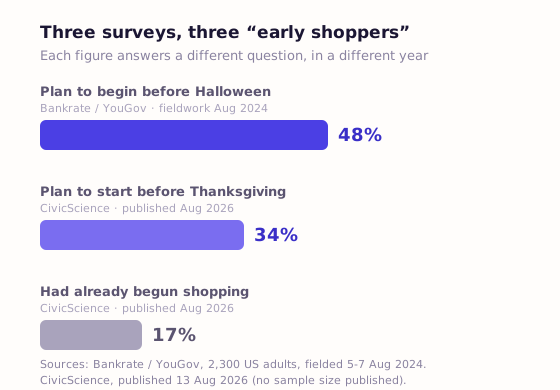
Forty-eight percent, seventeen percent, thirty-four percent. They can’t all describe the same behaviour, and they don’t. One asked about intention to purchase. One asked whether purchasing had started. One asked about planning, which isn’t purchasing at all.
The blogs that dominate this search quote them interchangeably. That’s how you end up reading that “half of people start before Halloween” and “most people haven’t started yet” in the same afternoon.
Shopping was never the bottleneck
Here’s what every one of those surveys has in common. They all measure buying. None of them measures whether you know what to buy.
That’s the actual constraint. You can’t shop early for a gift you haven’t thought of. Move your shopping from December to October and you haven’t solved anything — you’ve just moved the same blank stare to a nicer month.
Think about where gift ideas actually come from. Your brother mentions a thing he’s been meaning to replace, in March. Your daughter stops in front of something in a shop window, in June. Your mum says “oh, I’d never buy that for myself” about a specific object, in a specific shop, in August.
Those are the good ones. They’re specific, they’re wanted, and they’re free — you already have them. And every one of them is gone by November, because it lived in a conversation and nowhere else.
The gift you buy in December is almost never one of those. It’s a substitute, chosen under time pressure, for an idea you had and lost. That’s why December feels bad even when the shopping goes fine.
So the plan below has a different first step from every other Christmas timeline. Before the budget, before the sales, before any of it: keep track of the gift ideas that are already arriving.
September — collect, don’t buy
September’s only job is to end the month with a list of names and at least one real idea against each one. You spend nothing.
Start with the names, not the gifts. Write down every person you’ll buy for. Most people underestimate this list by three or four — the neighbour, the teacher, the person whose gift you always remember on 20 December.
Then, for the next four weeks, capture ideas the moment they happen. Not later. The whole failure mode is “I’ll remember that,” and you won’t. Use whatever you like: an app, a note per person, a paper list on the fridge. The requirement is only that saving takes under ten seconds and the idea lands against the right person.
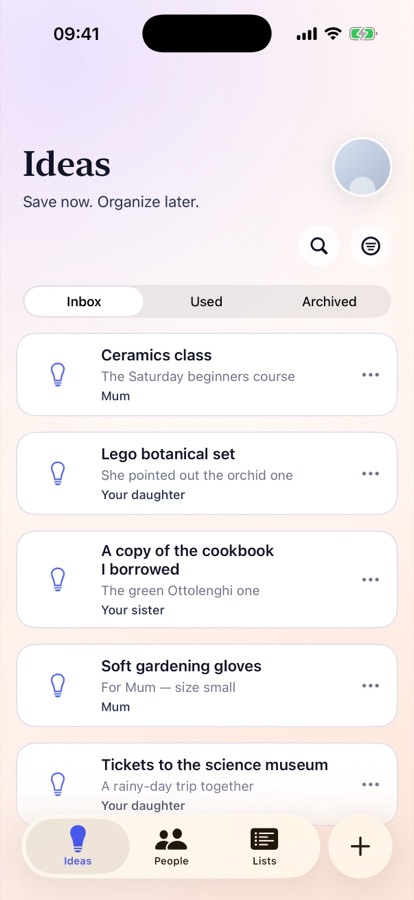
You’re not deciding yet. Six half-ideas beat one carefully chosen gift. The six give you something to choose between.
Here’s what that looks like in practice. Say you buy for seven people. By the end of September your list might read:
- Mum — the ceramics class she’s mentioned twice
- Dad — nothing yet
- Your daughter — a specific Lego set, the one she stopped in front of in August
- Your son — nothing yet
- Your sister — the cookbook she borrowed and never gave back
- Brother-in-law — nothing
- Your daughter’s teacher — nothing
Three ideas, four blanks. That looks like a failure. It isn’t. That’s a September list doing exactly its job: it tells you four people need real thought and three don’t. You now have eight weeks to solve four problems, instead of eight days to solve seven.
Compare it to the version where you wrote nothing down. Same seven people, same four hard ones — except you find out in December, and the three easy ones are gone too. Nobody remembers a shop window from August.
This is also the month to notice who you have nothing for. That’s the useful signal. Four months is plenty of time to fix an empty list. Four weeks isn’t.
October — turn ideas into a list per person
October is when a pile of ideas becomes something you can act on and hand to somebody else.
Go person by person. Pick the one you’d actually buy, plus a backup. Set a rough budget per person now, while you’re calm, rather than at the till in December when every number looks reasonable. Mark the people you still have nothing for and go looking — you have time, and this is the last month where that’s true.
October is also when the sales start, and this is where the planning pays off. Deloitte’s 2025 holiday retail survey found 38% of consumers were drawn in by October promotional events, up from 24% in 2023 (Deloitte).
October promotions are real, and they’re growing. But a sale only helps someone who knows what they’re looking for. If you walk into October with a list, the discount is a discount. If you walk in without one, it’s just an invitation to buy something you’d never have chosen.
Set the number before you pick the gift, too. Numerator found 84% of shoppers expect to spend more than $100 on Christmas in 2026. Deloitte’s 2025 survey found 77% expected higher prices, with 89% planning to hunt for deals. Both of those go better from a list. A budget per person written down in October is a constraint you chose. A budget discovered in December is just the number at the bottom of the receipts.
If you’re choosing a tool for this rather than a notebook, I’ve compared the family wishlist apps — including the ones I didn’t build.
November — share it, then buy against it
Share the list before Black Friday, not after. This is the step people skip, and skipping it is what produces duplicates.
Deloitte’s 2025 survey found 82% of consumers planned to shop Black Friday–Cyber Monday, up from 79% the year before. If the rest of your family is buying that weekend and they haven’t seen your list, the coordination is already too late to matter.
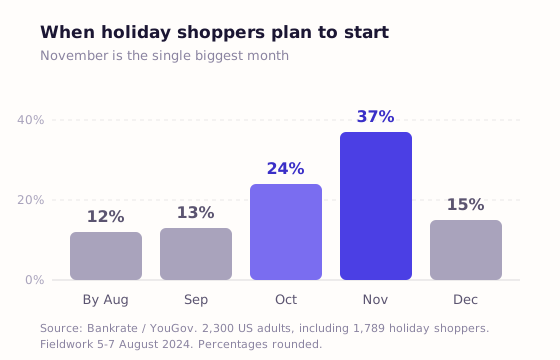
That Bankrate data shows the crunch clearly. 37% start in November — the single biggest month, bigger than August, September and October combined in that survey.
Two things make sharing work:
Send it somewhere they already read messages. Not an app they’d have to install. If your relatives have to create an account to see what your child wants, they won’t. You’ll be back to fielding “what should I get her?” texts in December. There are ways to share a list relatives can open without installing anything.
Make it possible to claim items. A list nobody can mark is a suggestion box. It tells your family what to buy but does nothing to stop two relatives buying the same thing. Claiming is the entire point of sharing.
Then buy against the list instead of browsing. Browsing in November is how you end up with a fourth idea for the easy person and still nothing for your father-in-law.
December — logistics only
If September through November went well, December is shipping and wrapping. No decisions.
The main thing December can still ruin is delivery. USPS had not published its 2026 holiday deadlines as of early September 2026. The 2025 dates went out in mid-September 2025, so this year’s are due imminently — check before you rely on anything below. For 2025 the recommended send-by dates were 17 December for Ground Advantage and First-Class Mail, 18 December for Priority Mail, and 20 December for Priority Mail Express (USPS).
Don’t plan against last year’s dates. Check the current ones when they land, work backwards, and set yourself a reminder a few days earlier than the official cutoff.
Two other December jobs, both small if you did the rest:
- The person you still have nothing for. There’s usually one. With a list in hand, it’s one problem, not eight.
- The gift you forgot to buy for yourself to give. Wrapping paper, cards, batteries. Nobody plans these and everybody needs them.
What to do if it’s already November
Most people reading a Christmas planning article aren’t reading it in September. Here’s the compressed version.
Run the same sequence in two weeks instead of three months, and cut the optional parts:
- Names first. Twenty minutes. The full list, including the people you’ll otherwise forget.
- One idea each. No backups, no second-guessing. Good enough beats unchosen.
- Share it immediately. Before the weekend, not after. Coordination has value only while people still have money left to spend.
- Buy against it. In one sitting if you can.
What to drop, specifically: the backup ideas, the budget-per-person, and the urge to find something perfect for the hard person. In a two-week run, perfecting one gift costs you the other six.
That’s the whole thing minus the slack. It works, it’s just tighter — and unlike the December version, it still ends with everyone getting something they actually mentioned wanting.
What to do next
The date to circle isn’t a shopping date. It’s the date you start writing things down.
- In September, list the people and start catching ideas as they arrive. Cost: nothing.
- In October, pick one gift per person and a backup, and set the budget.
- In November, share the list before Black Friday, then buy against it.
- In December, ship early and stop making decisions.
And if the ideas are the part you keep losing, that’s the problem Skarbi exists to solve. The offhand comment in March that would have been perfect. Save the idea when it happens, sort it out later.
Either way, start with the names. Everything else is downstream of knowing who you’re buying for.
Tagged: gift-planning, christmas, family, wishlist