How to keep track of gift ideas all year (the system, not the app)
By Volodymyr Pavlenko · · Updated
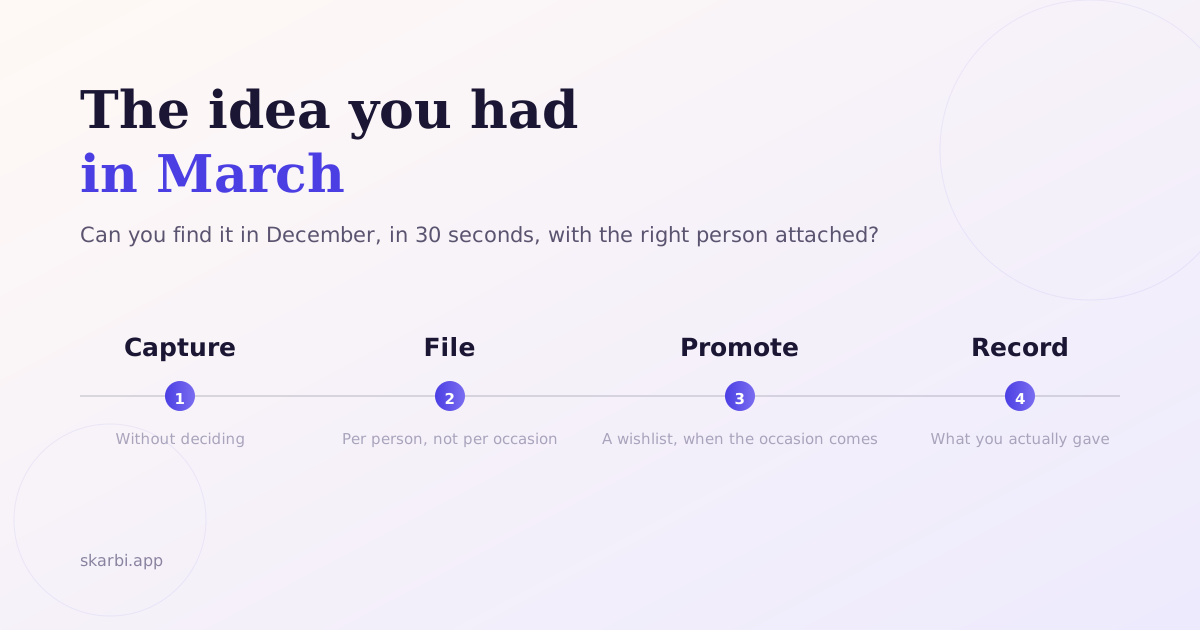
Your daughter stops in front of something in a shop window in June. Your brother mentions a thing he’s been meaning to replace, in March. By November both are gone, and you’re browsing a retailer’s homepage hoping something jumps out.
That gap — between the idea arriving and the occasion needing it — is the whole problem. The month-by-month Christmas plan covers what to do about it in one specific season. This is the system underneath, the one that runs the other eleven months.
The short version
A gift idea system works if you can answer one question: the idea you had in March — can you find it in December, in under 30 seconds, with the right person attached? Screenshots, the Notes app, and the family group chat each fail that test for a different structural reason, and knowing which reason tells you what to fix. What passes is four steps: capture without deciding, file per person rather than per occasion, promote to a wishlist only when an occasion arrives, and record what you actually gave. Capture is the step that decides whether the rest of it ever happens.
The test that tells you if your system is working
Here’s the test. Pick a gift idea you had at least six months ago. Find it, in under 30 seconds, and tell me who it was for.
Do it now, on your own phone, before reading further. Most people fail on the second condition rather than the first — the idea is in there somewhere, but nothing connects it to a person, so finding it means recognising it, and recognising it means already remembering it. Which defeats the point.
Three conditions, and each one is doing work:
Under 30 seconds, because retrieval speed determines whether you bother. A system you have to sit down with is a system you consult in December and never in June.
At least six months old, because everything works for a week. The camera roll is a perfectly good gift tracker for four days. The failure only shows up at the distance where it matters.
With the person attached, because an idea with no recipient is trivia. “A ceramics class” is not a gift idea. “A ceramics class, for Mum” is.
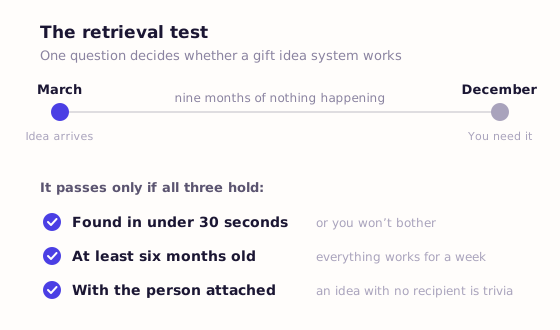
That test is deliberately narrow, and it is the only definition of success on this page. Every recommendation below exists to pass it.
Why the usual systems fail
Each common method fails the test for a different reason. Not because the tools are bad — because each one silently drops a field you need later.
| Method | What it captures | The field it drops | What happens in December |
|---|---|---|---|
| Screenshot to camera roll | The thing | Who it’s for | 4,000 photos, no way to filter to a person |
| Notes app | The thing, sometimes the person | Whether it’s still unused | You find it, then can’t recall if you already bought it |
| Family group chat | Everything, in order | Retrieval | Search returns 40 messages from the wrong November |
| Spreadsheet | All of it, properly | Capture speed | Never opened at the moment the idea actually arrives |
| Memory | Nothing durable | All of it | The December blank stare |
The spreadsheet row is the interesting one. A spreadsheet is a genuinely excellent gift tracker — structured, searchable, one row per person, columns for everything. It fails anyway, because a gift idea arrives while you’re standing in a shop or halfway through a conversation, and nobody opens a spreadsheet in either situation. It’s not a bad system. It’s a good system with a broken front door.
This is the general shape of the problem. Gift-idea systems don’t fail at organisation. They fail at capture, and then get blamed for being disorganised.
Which dedicated tools hold all four fields at once is a separate question, and the comparison of family wishlist apps works through seven of them. But the method below doesn’t depend on any of them. It works in a notes app, as long as the notes are filed by person. If that is your setup, use the compact Notes workflow to preserve context and status without building a complicated system.
Step one: capture without deciding
The only job at capture time is not losing the idea. Nothing else.
That sounds obvious and it is the step almost everyone gets wrong, because the natural instinct is to file properly while you’re there. Which occasion is this for — birthday or Christmas? Is it too expensive? Is it actually a good idea, or did it just seem good for a second? Every one of those questions is reasonable, and every one of them is a reason to do it later. Later means never.
So separate the two jobs completely. Capture is a reflex that takes seconds and requires no thought. Deciding happens on a different day, when you have one.
In practice that means the capture step needs exactly two fields:
- The thing — a link, a photo, or a line of text. Whatever is fastest where you’re standing.
- The person — who it’s for.
Nothing else is required at that moment. No occasion, no price, no category. Call the collection an inbox — a place things land before anyone decides what they are. An unassigned idea can sit in a person’s inbox for months without ever needing to be more than a link and a name.
The practical test for your own setup: can you save an idea one-handed, in under ten seconds, without leaving the app you’re already in? If the answer is no, the capture step will erode, and the rest of the system erodes with it.
The four places ideas actually arrive
Ideas don’t arrive in one context, which is why a single capture method never covers all of them. There are four, and each needs a different route in.
A browser or a shop app. You’re looking at the thing. The share sheet is the fast path here — whatever you use should be reachable from it, so saving is two taps without switching apps. If your method requires opening something else, copying a URL, and pasting it, you have added three steps to the most common case.
A physical shop. No link exists. A photo of the shelf, or the object, is the whole capture. What matters is that the photo lands somewhere attached to a person rather than in the general camera roll, which is exactly the failure in the table above.
A conversation. The highest-value source and the hardest to capture, because you can’t stop mid-sentence to type. The realistic move is to capture immediately afterwards, in text, while the specific wording is still in your head. “Mum said she’d never buy herself a proper mandoline” is a better record than “kitchen thing for Mum”, and the difference is entirely in how soon you wrote it.
A message someone sent you. A link in a group chat is already a captured idea sitting in the wrong container. Forward or share it out of the chat the same day, or it joins the 40 messages from the wrong November.
What makes an idea worth keeping
Not every note you take is a usable idea. The ones that survive to December have three things:
- A specific object, not a category. “A book” isn’t retrievable; a title is.
- The person, obviously.
- Where it came from, when the source is the point. “She said this herself, in August” carries information that “gardening gloves” does not — it tells you the idea is wanted rather than guessed.
Everything else is optional. Price changes, links rot, and sizes get confirmed later. None of that is worth slowing the capture down for.
A captured idea should be allowed to sit in exactly this state — a thing, a person, and an occasion field left deliberately empty:
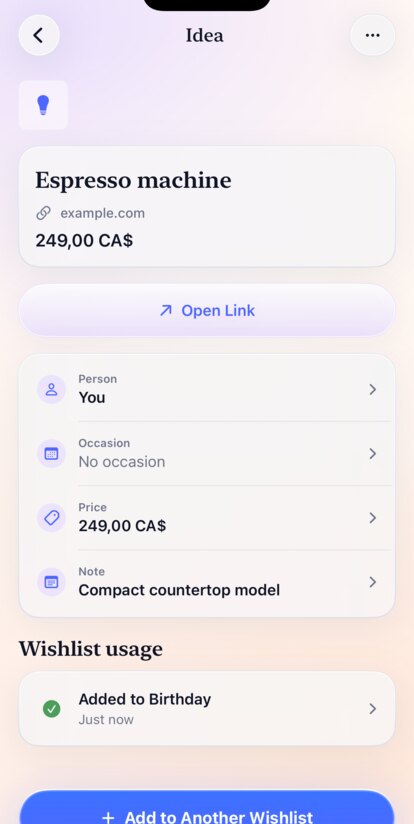
“No occasion” is not an incomplete record. It’s the correct one, for months at a time.
Step two: one inbox per person, not one list per occasion
File by recipient. People persist across the year; occasions don’t.
This is the single highest-leverage decision in the whole system, and it’s counterintuitive, because occasions are what create the deadline. A list called “Christmas 2026” feels like the organised choice. It isn’t, for a simple structural reason: it starts empty every single year, and it starts empty in November.
A per-person inbox starts filling in January. By the time a birthday arrives it already holds six months of ideas that came from real conversations, and choosing means picking the best two of nine rather than inventing something from nothing.
Now do the arithmetic on a normal household. Say you buy for six people — a partner, two children, two parents, one sibling. That’s six birthdays, plus Christmas for all six, plus the variable ones: an anniversary, a housewarming, a teacher at the end of term. Call it 14 or 15 gift moments a year, spread unevenly across twelve months.
Organised by occasion, that’s 15 lists, each built from scratch under time pressure. Organised by person, it’s six inboxes that fill continuously and get drawn from 15 times. Same ideas, same year — the difference is entirely in whether the container outlives the deadline.
Not everything you buy for is a person, either. A household, a shared hobby, a family holiday fund — these are spaces, and they work the same way as people do. The rule is that the container should be something that still exists next year.
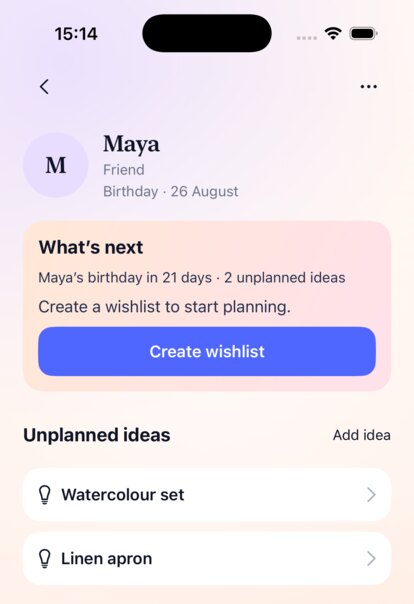
What a per-person container looks like when the occasion is finally close: the ideas are already there, and the only remaining job is choosing.
Step three: turn an inbox into a wishlist when the occasion arrives
The shareable list is the last step, not the first.
When a birthday is three or four weeks out, open that person’s inbox and choose. You’re editing down from a year of accumulated ideas, not starting from a blank screen — which is the entire payoff of the previous two steps, and the reason those steps are worth the small ongoing effort.
Choosing well takes about ten minutes:
- Read the whole inbox first. Ideas captured months apart often combine into one better gift.
- Check what you already gave. More on that in step four, but this is where it saves you.
- Size the list to the occasion. A shared birthday wishlist with 30 items isn’t helpful to anyone buying from it. Six to ten gives relatives a real choice without turning it into a catalogue.
- Leave the rest in the inbox. Unused ideas aren’t waste. They’re next year’s starting position.
Then share it. That handoff is where most family gift plans actually die — not at the list, but at the moment a relative taps the link and hits a registration form. It’s a separate problem with a separate fix, covered in how to share a gift list with relatives who won’t install an app. If you’re maintaining the list on behalf of someone who can’t maintain their own, making a wishlist for your child covers the on-behalf-of case.
Step four: close the loop
A system that only records intentions decays. Record outcomes too.
There are two loops, and they fail in different directions.
What you gave. Write it down at the moment you give it, in the same place the ideas live. Across a single year memory is fine. Across four years it isn’t, and repeat gifts are a quietly common way for a genuinely thoughtful present to land badly. A gift history also tells you what worked — which is the closest thing to a shortcut this system offers.
What other people are buying. The second loop is coordination, and it only matters once more than one person is buying for the same recipient. The mechanism you want is a reservation that other givers can see and the recipient cannot. Avoiding duplicate gifts goes into how that works and which tools get the visibility rules right.
Some scale for the cost of skipping this: Finder projected that 53% of US adults would open at least one unwanted present in 2024, at an average of $72 each, totalling around $10.1 billion (Finder). Read that figure carefully, because Finder is explicit about its limits — the 2024 number is a projection from its own 2022 and 2023 surveys of roughly 2,000 US adults each, conducted by Qualtrics/SAP, not a fresh count. Treat it as an order of magnitude, not a measurement. Not all of that is duplicates or repeats, and no system fixes the gifts that were simply wrong. But the ones you can fix are the ones a closed loop catches.
What a year actually looks like
The four steps describe the mechanism. Here’s the shape of them running, for a household buying for six people — this is an illustration of the sequence, not a case study.
January to March. Nothing scheduled happens. Four ideas get captured, all of them incidental: a comment about a worn-out coat, a shop-window thing your daughter stopped at, two links from a group chat. Total time spent: under a minute, spread across three months.
April. A birthday. You open that person’s inbox and find three ideas waiting, two of which you’d genuinely forgotten. You pick one, buy it, and record it as given. The other two stay put.
May to August. Six more ideas land. One of them is the mandoline comment. You capture nothing at all in July, which is fine — the system has no weekly obligation to fail at.
September. The annual pass, 20 minutes. You clear out three ideas that no longer fit, notice one person’s inbox is nearly empty, and pay attention to that person for the next few weeks. That’s the entire maintenance burden for the year.
October and November. Christmas. Six inboxes, each holding between two and nine unused ideas. You choose per person, build a wishlist for the two people who need one shared, and send the links before the sales start. You are choosing, not searching.
December. Buying and logistics. No decisions left.
The point of writing it out is the ratio. The capture work is measured in seconds and spread across twelve months. The concentrated work is two sessions — one in September, one in October. Everything else is a by-product of decisions you were making anyway.
Making it survive a real year
The system fails at maintenance, not at setup. Nearly everyone can set one up in an afternoon in October. Almost nobody is still running it the following June.
The fix is to have fewer maintenance moments than you think you need. Three, and only one of them is frequent:
Capture — continuous, seconds at a time. Not a habit you schedule. A reflex that happens when the idea does.
A review before each occasion — about ten minutes, roughly 15 times a year. This is step three. It has a natural trigger, so it doesn’t need remembering.
One annual pass — 20 minutes, once. Clear out ideas that no longer fit, check the gift history, note anyone whose inbox is suspiciously empty. Early autumn is the natural slot, because it’s before the season starts rather than during it.
That’s it. No weekly review, no inbox zero, no maintenance ritual that competes with the rest of your life.
There’s a useful piece of evidence about why the capture half has to be continuous rather than seasonal. In the National Retail Federation’s 2025 holiday survey — conducted by Prosper Insights & Analytics with 8,247 US adults between 1 and 7 October 2025, margin of error ±1.1 points — 42% of shoppers said they planned to begin holiday shopping before November, and their leading reasons were spreading the budget (54%) and avoiding the stress of last-minute shopping (41%) (NRF). In the same survey, 63% said they’d wait until Thanksgiving weekend to do most of it, up from 59% a year earlier.
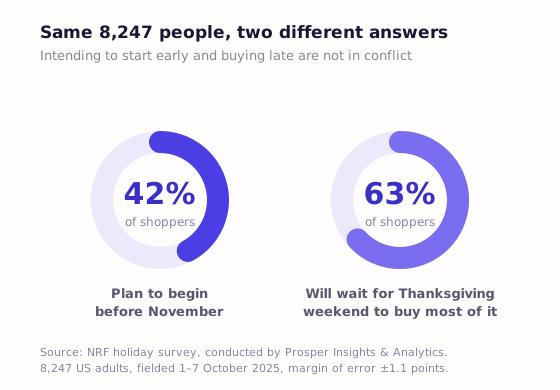
Both figures are from the same 8,247 people. They intend to start early and they concentrate their buying late, and there’s no contradiction there — buying early and knowing what to buy early are different problems. Deloitte’s 2025 Holiday Retail Survey found 58% of shoppers consider holiday shopping stressful (Deloitte), and the NRF’s own tracking put consumers at just over half (51%) of their shopping completed as of early December (NRF).
Which is the argument for this whole system, stated in survey data: the buying compresses into a few weeks no matter what anyone intends. The thinking is the part that can be spread across the year, and it’s the part that actually improves the gift.
When this is overkill
Four cases where you should close this tab.
You buy for one or two people. A single note is genuinely enough. It needs no setup, it never decays, and everything above is overhead you won’t recover. The system earns its keep somewhere around four recipients, when filtering by person starts to matter.
December shopping works for you and you enjoy it. Some people are good at this under time pressure and find the season fun. Nothing here improves that.
You need a wedding or baby registry with purchase tracking. That’s a different tool category — registries handle store integration, shipping, and returns in ways a gift idea system doesn’t try to. MyRegistry and the other registry-first tools in the comparison linked above are the right shelf to look on.
Your household is on Android. Skarbi is iOS-only. The method on this page is tool-agnostic and works in a notes app on any platform, but if you were reading this looking for the app, that’s the answer.
What to do next
Run the test first. Pick an idea from at least six months ago, find it in 30 seconds, name the person. If that works, your current setup is fine and nothing here is worth changing.
If it doesn’t, the four steps:
- Capture without deciding. Two fields — the thing and the person. Under ten seconds or it won’t survive.
- File per person, not per occasion. The container has to outlive the deadline.
- Promote to a wishlist when the occasion arrives. Choose from a year of ideas instead of a blank screen.
- Record what you gave. Memory is fine for one year and unreliable across four.
That method works in any tool that stores a thing and a person together. Skarbi is built around exactly this shape — an inbox per person, ideas captured before they’re assigned to anything, and a wishlist that guests can open and reserve from without installing anything. But the sequence is what matters. The tool is a detail.
Tagged: wishlist, family, gift-planning, workflow