How to avoid duplicate gifts in a family (without spoiling the surprise)
By Volodymyr Pavlenko · · Updated
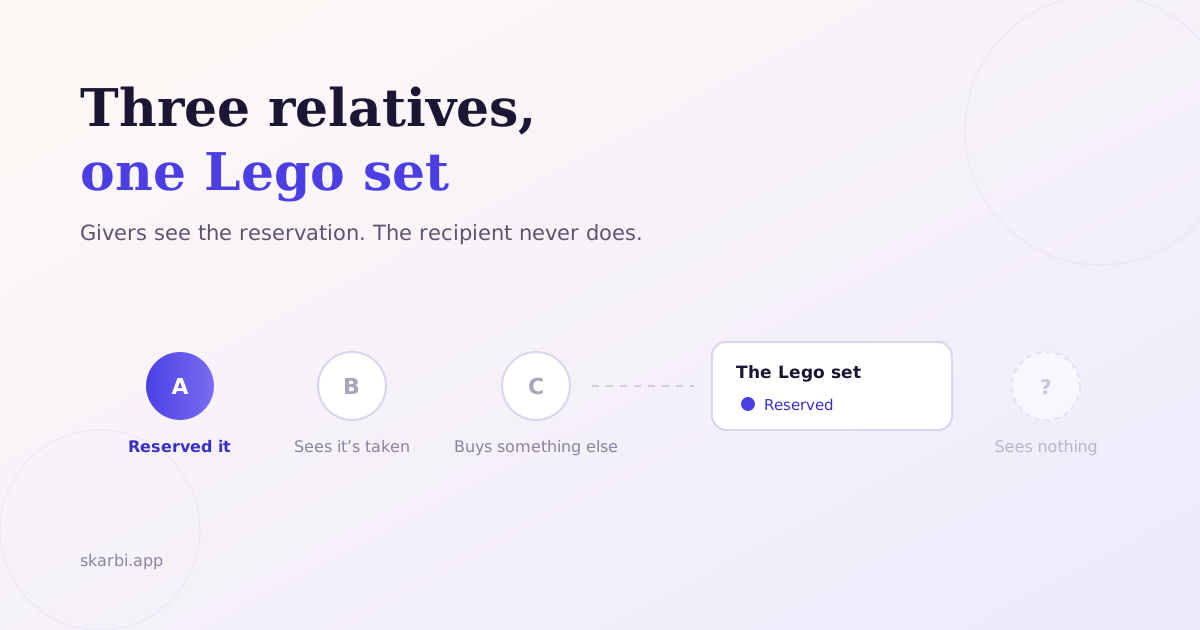
Two aunts and a grandparent buying the same Lego set for the same birthday is one of the most preventable failure modes in family gifting — but only if the wishlist tool you’re using supports reservations that stay hidden from the recipient.
The mechanism
A modern family wishlist app should let a gift-giver mark an item as “I’m buying this” in a way that:
- Other gift-givers see the reservation — so they don’t buy the same thing.
- The wishlist owner does not — so the surprise stays intact.
That second half is the part most tools get wrong. If the person who wrote the list can see who reserved what, opening the app becomes a spoiler. And people do open the app — that’s the whole point of having made a list.
Why group chats fail at this
The default family solution is a chat thread, and it fails for a structural reason rather than a discipline one.
The recipient is usually in the family chat. So coordinating there spoils the surprise, and the workaround — a second thread that excludes them — has to be created fresh for every occasion and every recipient. It works in December and is forgotten by March. Worse, chat has no state: “I’ll get the bike” scrolls away, and the person who joins the conversation four days later has no way to see what’s already claimed without reading back through everything.
A reservation is the same message, but it sticks to the item instead of scrolling past.
What actually works
- Skarbi hides both the reservation and the reserver’s identity from the recipient. Guests reserve without an account.
- Moonsift has a gift-list mode where loved ones can mark items as purchased and the owner doesn’t see who bought what until they ask.
- Giftster hides purchases from the list maker, and its website has a guest mode that lets a non-member mark an item purchased on a public list without an account — though the guest supplies a name and email, and the mobile apps do not support it.
- Elfster protects the surprise inside its exchange model, which expects participants to be part of the specific exchange.
The group requirement is not a small footnote. It decides whether the relative who buys one present a year can participate at all — which is why it’s worth reading closely in a head-to-head of the two family-first options before committing a whole family to one.
What doesn’t
Shared Google Doc, a Notes app screenshot in the family group chat, or a plain Amazon wish list — none of these hide reservations from the list owner. Someone always spots the change.
Amazon lists deserve a specific warning: the list owner can see purchased quantities. The item quietly shows as bought. It is not a surprise-protecting mechanism, however much it looks like one, and a Notes-based list has an even shorter shelf life.
The three-step version
- Make the list specific. “Something for the garden” invites two people to guess and converge. A named item, ideally with a link, does not.
- Share one link, not a screenshot. A screenshot cannot be reserved against. It has no state, and it goes stale the moment anything changes.
- Check that the owner is blind to reservations before you rely on it. This is the one property people assume and rarely verify.
When it happens anyway
Some duplicates get through — usually from the relative who bought early, off-list, without telling anyone. Two things make that recoverable.
Keep receipts and gift receipts together. Not romantic, but the whole problem becomes a ten-minute errand instead of an awkward decision about which aunt’s present gets quietly returned.
Decide in advance who gets told. The failure mode isn’t the duplicate; it’s four relatives finding out on the day, in front of the child. If you’re the one coordinating, the useful move is to absorb it privately: thank both, return one later, and don’t stage a discussion about it at the party.
A duplicate that nobody mentions is a non-event. A duplicate that becomes a conversation is the thing people remember about the birthday.
Mixed families: some use the app, some don’t
Most families never get to full adoption, and a system that requires it will fail. The workable pattern is one person holding the list and everyone else touching a link — no accounts, no installs, no group to join. The coordinator maintains it; everyone else just reserves. That asymmetry is the difference between a system that survives a second year and one that quietly dies in February.
Reservations are the last line of defence, not the first
None of this helps if you can’t share the list in the first place — reservations only prevent duplicates when the relatives doing the buying can actually reach the list without creating an account.
And they’re a backstop rather than a plan. Two aunts converge on the same Lego set because the list was vague enough to leave them guessing. The duplicates that never happen are the ones where somebody kept track of the gift ideas per person through the year, so the list going out is specific enough that nobody has to guess. Reservations catch the collision; specificity prevents it.
For a full comparison of surprise-protection behavior across seven family wishlist apps, see the family wishlist app roundup.
Tagged: wishlist, family, gift-planning, duplicate-prevention