Skarbi vs Giftster: which family wishlist app fits your family?
By Volodymyr Pavlenko · · Updated
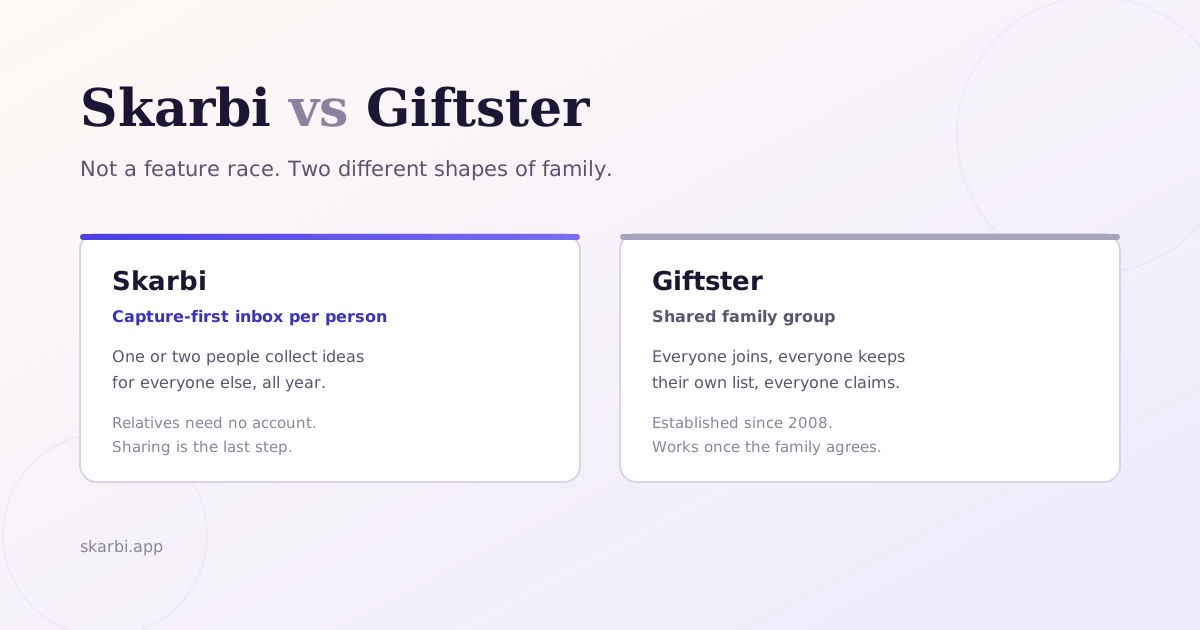
Skarbi and Giftster are the two apps that take family gift planning most seriously — most competitors either optimize for shopping or for a specific event like Secret Santa. The difference between them is structural, not feature-by-feature, and that means the wrong pick isn’t a slightly worse app. It’s an app your family quietly stops using in March.
The one-sentence answer
Choose Giftster if your extended family already coordinates as a group and each adult wants to maintain their own year-round list. Choose Skarbi if one or two people in the family end up capturing gift ideas for children, partners, and relatives, and you need somewhere to save those ideas before deciding which occasion they belong to.
Side by side
Last checked: 4 September 2026. Both apps change; verify anything that would decide it for you before you commit a whole family to one.
| Skarbi | Giftster | |
|---|---|---|
| Core model | Capture-first inbox per person or space | Shared family group, each member keeps a list |
| Who does the work | One or two planners, on everyone’s behalf | Every member, for themselves |
| Platforms | iPhone only | Cross-platform, including Android and web |
| Account to plan | Required (Apple or Google sign-in) | Required |
| Guest reserving | Public link, any browser, no account, nothing to type | “Shop as a guest” on a public list in any browser, no account — but the guest gives a name and email. Not supported in the iOS or Android apps |
| Reserver stays anonymous to the owner | Yes — neither the reservation nor the reserver is visible | Purchases are hidden from the list maker, but guest name and email are recorded, and Giftster cites registry cases where the maker sees who marked an item |
| Adding items | Link, photo, or a plain-text note | Items from any online store |
| Children | Per-person inbox — a child has no account at all | Child accounts, created and managed under a parent’s login |
| Free tier | 3 people or spaces, 3 active wishlists, 1 shared | Everything — Giftster states it is entirely free |
| Paid tier | Skarbi Pro, $2.99/mo or $11.99/yr (US) | None |
Where they diverge
Giftster is a shared family group. Everyone joins, everyone maintains their own list, everyone can claim gifts on other members’ lists, and a parent can run a child’s list from their own login. It works well when the extended family has already agreed to use one system together — and that agreement is the load-bearing part. When it holds, Giftster is excellent, because the person who knows best what they want is the person writing it down.
Skarbi is a capture-first inbox per person. You keep a running list of gift ideas for each family member — including people who don’t have accounts anywhere — and turn any of those inboxes into a shareable wishlist when a birthday or holiday approaches. Grandparents open the shared link in a browser and reserve without installing anything.
The distinction that matters: Giftster assumes the recipient will tell you what they want. Skarbi assumes you noticed it yourself, in March, and need it to survive until December. That’s the gap most gift ideas die in — not the list, the nine months before it.
Where Giftster is the better choice
Comparisons written by one of the two products are worth exactly as much as their willingness to say this part, so:
Giftster works on Android and the web. Skarbi does not. Skarbi is iPhone-only, with no Android version and none to promise you. If anyone who needs to make a list in your family is on Android, this is the whole decision and nothing below it matters. Giftster wins by default.
Giftster scales across an extended family better. Once a family group is established, adding a cousin is one invitation and that cousin curates for themselves. Skarbi’s model concentrates the work on whoever is doing the planning — which is the point when that’s already how your family works, and a burden when it isn’t.
Giftster is free, and Skarbi is not. Giftster’s own help states plainly that it costs nothing. Skarbi’s free tier caps you at 3 people or spaces, 3 active wishlists and 1 shared wishlist, and lifting those limits costs $2.99 a month. For a large family that is a real difference, and it is worth naming rather than burying.
Giftster has been doing this longer, at far greater scale. It advertises more than three million members and active users in 40 countries, plus a browser extension, an auto-fill tool for pasting in product links, and a built-in Secret Santa draw — none of which Skarbi has. If your family already has a Giftster group with three years of history in it, the migration cost is real and the benefit of switching probably isn’t there.
Where Skarbi is the better choice
When the giver, not the recipient, is the one paying attention. Small children don’t maintain wishlists. Neither do most partners, or grandparents, or the friend who mentions their headphones are dying and then never thinks about it again. Skarbi is built for capturing on someone else’s behalf.
When you can’t make people install anything. This is the most common failure mode in family gift coordination: the system works for the two people who set it up and nobody else. Skarbi’s shared wishlist is a link. It opens in a browser, on any device, and reserving takes no account and no install — which is also how you share a gift list with relatives who won’t install an app.
Giftster gets close here, and it is worth being precise about the gap rather than overstating it. Its website has a genuine “Shop as a guest” mode with no account. But the guest is asked for a name and an email address, the list has to be found through member search rather than opened from a link you were sent, and Giftster’s own help describes registry cases where the list maker can see who marked an item. Skarbi’s guest reserves from the link they were sent, types nothing, and stays anonymous to the owner. Whether that difference matters depends entirely on whether the surprise or the thank-you note is the priority.
When ideas arrive long before occasions. The per-person inbox exists so an idea has somewhere to go before you’ve decided whether it’s a birthday present or a Christmas one. If you’re already keeping that list somewhere — a note, a screenshot folder, a running text to yourself — that’s the workflow Skarbi is replacing, and there’s a fuller version of it in our guide to tracking family gift ideas year-round.
How to actually decide
Ask one question: who in your family will reliably open an app?
If the answer is “most of the adults, and they already do” — Giftster. The group model turns that willingness into a system, and you get the accuracy benefit of everyone describing their own wants.
If the answer is “me, mostly” — Skarbi. Planning for other people is the case it’s designed around, and the sharing step is built so nobody else has to participate in the tooling at all.
If the answer includes anyone on Android who needs to build a list — Giftster, and it isn’t close.
Neither is universally better. Both are free to start. The right pick depends on whether your family is a group of self-list-maintainers or a household where one or two people are doing the gift-planning work — and on which phones they’re holding.
For the full seven-app comparison, including Elfster, GoWish, Moonsift and MyRegistry, see our roundup of family wishlist apps. If the immediate worry is two relatives buying the same thing, avoiding duplicate gifts covers the reservation mechanics in both models.
Tagged: wishlist, family, gift-planning, comparison, skarbi, giftster